

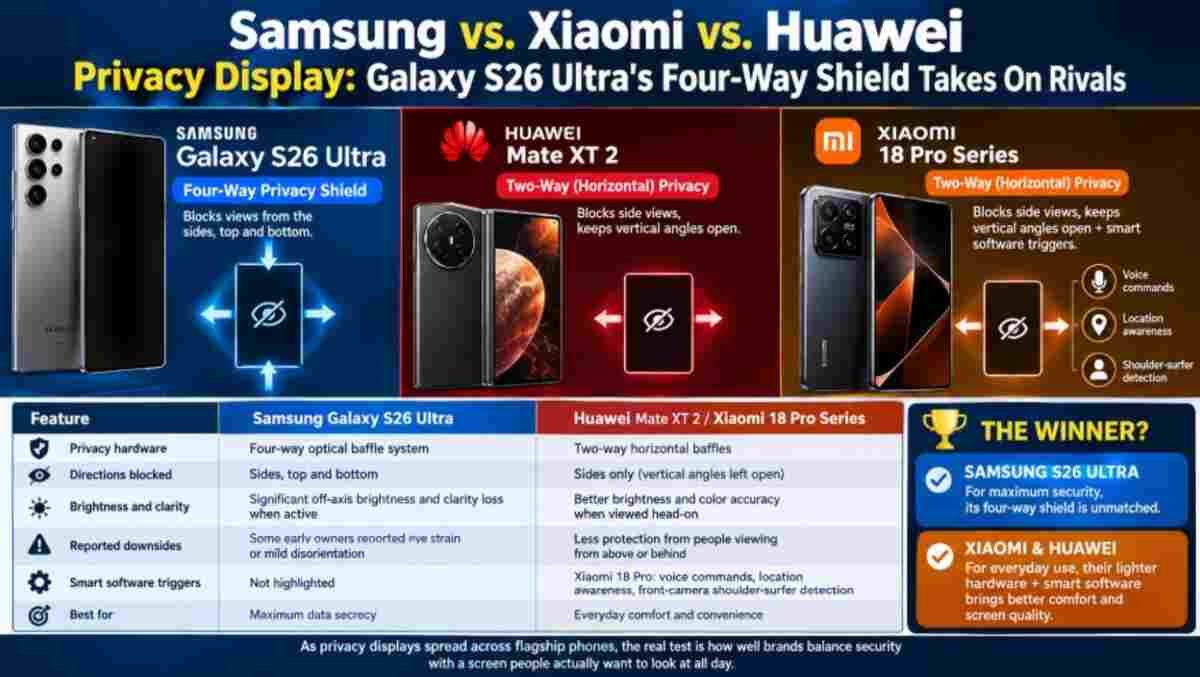
Samsung’s Galaxy S26 Ultra has the strongest privacy display hardware on the market right now, using a four-way optical baffle that blocks views from the sides, top and bottom. The catch is lower brightness and clarity when the mode is on. Huawei’s Mate XT 2 and Xiaomi’s 18 Pro series protect only against side views, but they keep the screen brighter, and Xiaomi adds smart software triggers that make the feature easier to live with day to day.
Built-in privacy screens have quickly become one of the most competitive features in mobile tech. Anyone who has checked a banking app on a crowded bus knows the problem: a stranger standing close enough to read your screen.
Samsung pioneered built-in hardware protection with the Galaxy S26 Ultra’s Privacy Display. Now Huawei, with its foldable Mate XT 2, and Xiaomi, with its recently announced 18 Pro series, have entered with their own takes. The question is which approach works better: maximum lockdown or everyday comfort.
Samsung Galaxy S26 Ultra: The Four-Way Privacy Advantage
According to well-known tech tipster Ice Universe, Samsung still holds the crown for absolute privacy hardware.
How the Four-Way Optical Baffle Works
The Galaxy S26 Ultra uses a four-way optical baffle system that blocks viewing from the sides, top and bottom at the same time. Whether someone is standing beside you on the subway or leaning over your seat from behind, your screen appears blacked out to them.
How Huawei and Xiaomi Compare on Coverage
Huawei’s Mate XT 2 and Xiaomi’s 18 Pro series use two-way horizontal baffles instead. These block side glances well, which covers most public transit situations, but they leave vertical viewing angles open.
On paper, and in raw security capability, Samsung wins this round.
Security vs. Comfort: The Trade-Off
Maximum security comes at a real cost, and this is where the rivals close the gap.
Brightness and Clarity Loss on the Galaxy S26 Ultra
To achieve four-way blocking, Samsung gave up significant off-axis brightness and image clarity while the mode is active. Some early Galaxy S26 Ultra owners have reported eye strain or mild disorientation during long sessions because of the reduced light output.
Huawei and Xiaomi’s Middle Ground
Huawei and Xiaomi chose a gentler approach. By restricting only horizontal viewing angles, they keep much better panel brightness and color accuracy when the screen is viewed head-on.
Xiaomi 18 Pro’s Smart Privacy Features
Xiaomi goes further on convenience with software. The Xiaomi 18 Pro can turn on privacy mode through:
- Voice commands, for hands-free activation
- Location awareness, switching on automatically in certain places
- Shoulder-surfer detection, using the front camera to spot people looking over your shoulder in public
Privacy Display Comparison at a Glance
| Feature | Samsung Galaxy S26 Ultra | Huawei Mate XT 2 / Xiaomi 18 Pro series |
| Privacy hardware | Four-way optical baffle system | Two-way horizontal baffles |
| Directions blocked | Sides, top and bottom | Sides only (vertical angles left open) |
| Brightness and clarity | Significant off-axis brightness and clarity loss when active | Better brightness and color accuracy when viewed head-on |
| Reported downsides | Some early owners reported eye strain or mild disorientation | Less protection from people viewing from above or behind |
| Smart software triggers | Not highlighted | Xiaomi 18 Pro: voice commands, location awareness, front-camera shoulder-surfer detection |
| Best for | Maximum data secrecy | Everyday comfort and convenience |
Which Privacy Display Approach Wins?
For maximum security: If keeping your data completely hidden is the top priority, the Galaxy S26 Ultra’s heavy-duty hardware shield is still unmatched.
For everyday use: If you want quick, comfortable protection without giving up screen quality, Xiaomi and Huawei show that a lighter hardware approach paired with smart software often makes for the better overall experience.
As privacy displays spread across flagship phones, the contest is no longer just about blocking the most angles. The real test is how well brands balance security with a screen people actually want to look at all day.


